
JOYFUL PIECE #52
Make haste for less waste...

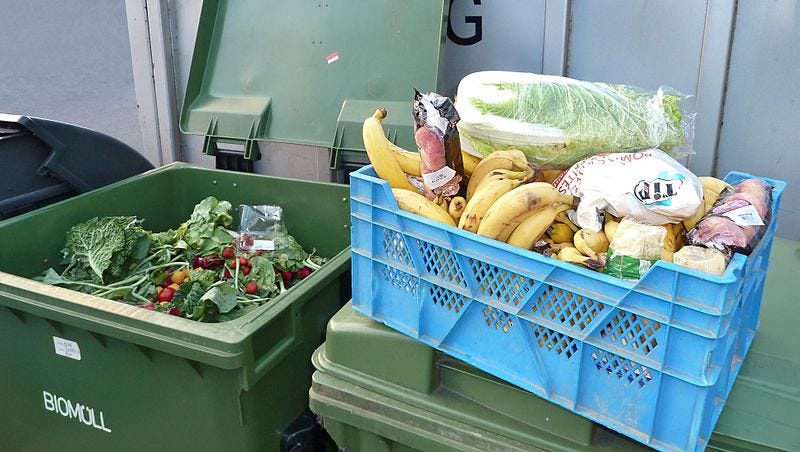
A box full of recovered vegetables and fruits dug out of the waste of a hypermarket. Image by Foerster, courtesy of Wikimedia Commons. ‡
These days the human population seems to continue to balloon. There are 8 billion of us here right now and we will be at 11.2 billion by the year 2100.
Our growth wreaks havoc on the environment. Waste accumulates on air, land and sea…
If we stop generating waste there are many social, economic and environmental benefits to be gained. Greenhouse gas emissions in landfills are reduced, mitigating global warming trends. Reducing the need for disposable plastic containers reduces the current danger faced by fish, fowl and other wildlife that make oceans and rivers their home.
Part of France’s plan in this regard is to ban supermarkets from throwing away unsold food and making big polluters financially responsible for created waste. In the U S, thrown away edible foods account for about 30% of our food supply. It is the single largest volume of landfill content, producing a huge amount of global warming greenhouse gases. Right now, we only donate 2% of unsold and uneaten food. What the French are doing is providing a broad front of waste reduction initiatives to save their environment.
Our economy has been dependent on always being in production mode. That has ingrained in us hard-to-break throw-away habits that load up landfills and litter our living environment. Why should we not consider moving away from the throw-away mentality to a different operating mode? Such a change requires innovative thinking to incentivize and/or nudge citizens into new ways of behaving— a cultural shift.
I do not wish to duplicate the excellent article that a good friend shared with me. You can read more on this approach here.
Other countries, our own Federal Government and many states and communities are also moving in this direction as noted in this article: White House Announces Strategy to Keep Edible Food Out of Landfills.
So, all is not lost, not by any means. We must change and we, in fact, can change by addressing our habits. And this is reason for joy!

Sounds like a shift to a much more enjoyable culture to me. Thanks for posting, Manuel.
Excellent topic and something each reader can start doing if they already aren't doing it. However the article you reference was way to long and confused me on what point(s) they were trying to drive to focus on. Your summary was far better and to the point.
In regards to saving food waste we were fortunate to take a Norwegian coast cruise this spring on Havana cruise line. They used portion control on all their meals. You could eat as much as you wanted but was served in portions. Thus, you are your portions and if you wanted more then would give it to you versus order more than you want and throwing away what you did not want, Their goal is to reduce 70 to 80% of their food waste. I found this as an interesting and effective way to address food waste on a cruise ship.