
SPEAKING OUR MIND
Ethos, pathos, logos

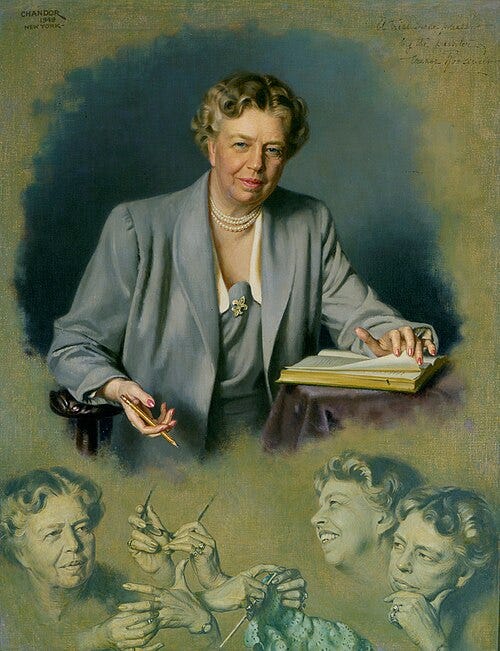
Ethics…Compassion…Reason
Anna Eleanor Roosevelt was an American political figure, diplomat, and activist. Through her travels, public engagement, and advocacy, she largely redefined the role of FLOTUS. Widowed in 1945, she served as a United States delegate to the United Nations General Assembly from 1945 to 1952, taking a leading role in designing the text and gaining international support for the Universal Declaration of Human Rights. In 1948, she was given a standing ovation by the assembly upon their adoption of the declaration. President Harry S. Truman called her the “First Lady of the World” in tribute to her human rights achievements.
She overcame serious challenges in her personal and public life, and in her time, was one of the world’s most widely admired and powerful women.
Nevertheless, in her early years in the White House she was controversial for her outspokenness, particularly with respect to her promotion of civil rights for African Americans. She was the first presidential spouse to hold regular press conferences, write a daily newspaper column, write a monthly magazine column, host a weekly radio show, and speak at a national party convention. On a few occasions, she publicly disagreed with her husband’s policies. She advocated for expanded roles for women in the workplace, the civil rights of African Americans and Asian Americans, and the rights of World War II refugees.
Following her husband’s death in 1945, Roosevelt pressed the United States to join and support the United Nations, becoming its first delegate to the committee on Human Rights. She was the first chair of the UN Commission on Human Rights and oversaw the drafting of the Universal Declaration of Human Rights. Later, she chaired the JFK administration’s Presidential Commission on the Status of Women. At her death, she was regarded as “one of the most esteemed women in the world” and “the object of almost universal respect” (NYT obituary).
How did she pull all of that off (and more)? Her approach reminds me of the wise advice that Karen S. Bonnell shared with me on how to take a stand:
Get very clear what you stand for from a policy perspective.
Do you believe that people should have equal access to healthcare? Stand for that.
In our conversations, much is lost in countering the waterfall of toxic water/political babble... let’s stay unequivocal about the basics:
Do we need to get corporate money out of politics?
Do we need to reform the Supreme Court?
Do we need to strengthen public education?
Do we believe forcing a woman to remain pregnant is a violation of human rights?
... whatever it is that lights your fire, and then the three or four things that fall from that, know what you stand for - vote your conscience!!!
📣
20260810
Links of interest:
https://en.wikipedia.org/wiki/Eleanor_Roosevelt
substack.com/@karensbonnell
Image credits: Douglas Chandor: Anna Eleanor Roosevelt (Mrs. Franklin D. Roosevelt), courtesy of Wikimedia Commons. Douglas Chandor died in 1953, so this work is in the public domain in its country of origin and other countries and areas where the copyright term is the author’s life plus 70 years or fewer.
REMINDER: Are you and your loved ones registered to vote? Get going, we need every voter engaged for a new beginning, free from the oppression from the POTUS and the Epstein Circle.
Vote— your life depends on it.
😉💪✅
Great historical reminder of someone you rarely hear about these daysRemember to vote and I think the voting your conscience is a great add vs I always vote this way. It's our country so we should decide which way it should be heading.