
PLANNING FOR NON-VIOLENCE
The fire alarms of wrath are going off in America's political world. A word of caution to stay centered and respond effectively may keep me from going off the deep end.

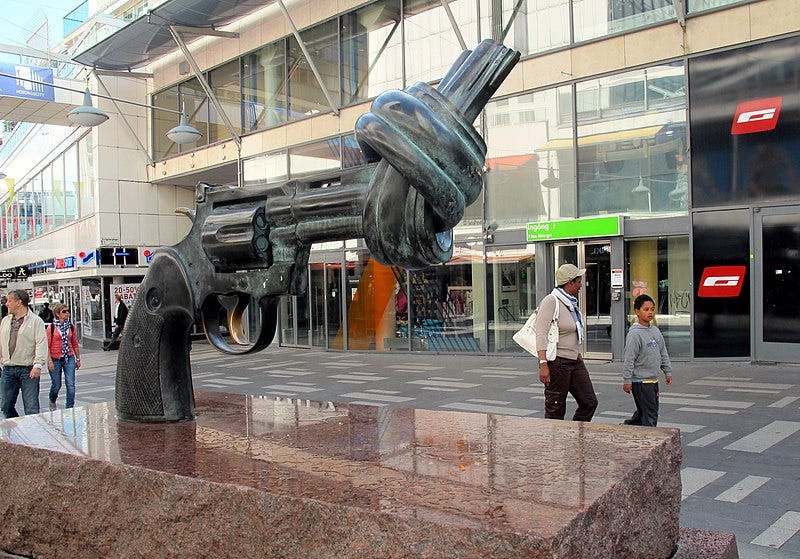
Non-Violence (sculpture) The Knotted Gun - Sergelgatan, Stockholm 2011 - Murat Özsoy.jpg, courtesy of Wikipedia Commons.
_The_Knotted_Gun_-_Sergelgatan,_Stockholm_2011_-_Murat_%C3%96zsoy.jpg)
There is no shortage of opinionated folks, writers, pundits, demagogues, and others ready to push my hot buttons that trigger deep feelings and emotions. These feelings and emotions have the potential of keeping me in a constant state of alertness. That alertness is likely to result in my unfiltered reaction at the speed of light rather than a measured and more effective response.
I find the Pelicaric/Koevoets guidelines, “The Four A’s”, to be a particularly helpful way to respond to hot button issues. Taking each of these “A’s” into consideration may allow me to pause and consider what these hot buttons are trying to get me to do. I may then be able to respond compassionately and effectively to a prod that in the past may have set me off. These are my takes on The Four A’s as I meditated on them:
The first A is Acknowledge. This requires that I acknowledge and name what it is that I am feeling in the presence of a hot-button prod. This does not imply inaction, but it suggests that I communicate what I am feeling in a restrained and civil way to the source of the irritation.
The second A is Allow. As I assimilate the irritant prod, taking a deep breath before verbalizing or acting out my feelings will allow me to consider the possible effects of a potential outburst. If my aim is to have effective and compassionate communications, allowing the feelings to “wash over me” does not dismiss the irritant, but places me in a condition of being able to align a response to a prod in a constructive manner. I can tell myself that I am capable to face the onslaught, the irritant, to hold back from a “nuclear option” response. This will in turn avoid escalation of a confrontation.
The third A is Ask. To me this is a deeper dive into my feelings. The irritant may have been intentional or unintentional. Asking myself about the source of my deep reaction or resentment to the irritant is very important. I must also be compassionate with myself at this step. I am human, I have feelings that have been hurt. What kind of message would I have preferred to have received from the irritating source?
The fourth A is Accept. I must accept my imperfection in allowing the irritant to get “under my skin”. It is ok for me to feel the hurt. But I need to reassure myself that I have what it takes to endure the discomfort. This could even require that I momentarily focus my attention on a pleasant thought— self soothing, so to speak. Being aware of my tight chest and muscle tension and releasing that stress through deep breathing and conscious relaxation can help me here.
Now, I don’t need to walk away. Instead, to the best of my ability in these trying times, I need to implement a measured and effective dialogue with the source of the irritation, keeping the temperature down, my delivery tone assertive yet measured, and the volume of my voice under control.
This is a tall order for me. But, as we get deeper into this political season, it is important to avoid escalating confrontations to unmanageable levels. We need to understand the grievances as perceived by the irritating source. They may even resemble our own!
Wish me luck!
What do you think?
This is the link to the meditation that I received that inspired this post: Healing Our Violence.

Good luck, dear one!✨✨✨