
JOYFUL PIECE #10
What Do We Really Know About The Universe?

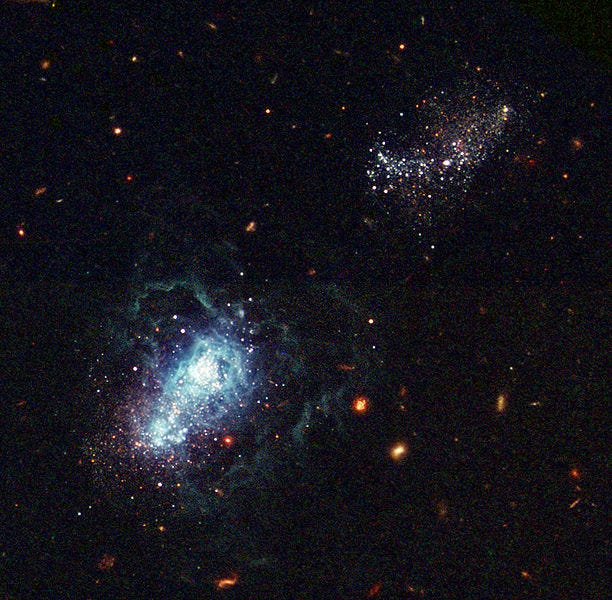
This image is in the public domain, courtesy of NASA and ESA
What an interesting essay, The Story of Our Universe May Be Starting to Unravel! This is one of the best essays on the topic of Cosmology that I have ever read. It is candid and refreshing in exposing what cosmology reveals about Creation.
To me, Cosmology is the study of how reality came to be, is developing, and where it is headed. If anyone claims to know with certainty how this all happened, is happening, and may continue to happen, beware of the car that is being sold— at least until the vehicle is test driven.
This statement could be considered a bit arrogant: “Not long after the James Webb Space Telescope began beaming back from outer space its stunning images of planets and nebulae last year, astronomers, though dazzled, had to admit that something was amiss.” Amiss from what, though? By whose measure can we assess the infinity of creation and determine that something is amiss?
We courageously seek to understand everything. But, to what degree is our understanding based on flawed assumptions? We need deep thinkers who can conceive hypotheses and develop theories that research later “confirms” hold together. Often, however, are we not dumbfounded by new findings that bring those theories into question and even into the dustbin?
We explore through our very limited abilities to perceive reality. We trust our senses and brain to allow us to perceive “reality”. How confident can we be that our brain and senses, developed over millions of years of evolution to enable our survival within the confines of diminutive planet Earth, can be trusted to extrapolate to the infinite Cosmos? What senses do we lack that will enable humans to truly perceive and understand the Cosmos? If we look at other life forms on Earth, we are continually astounded by their perceptive capabilities to detect activity far more accurately than humans.
I am not unsettled that the Webb finds previously unknown galaxies and phenomena. It is exciting that we can begin to get past our know-it-all arrogance. From my tiny and extremely limited perspective, I have always wondered how sound scientific theories are. Certainly, brilliant minds have proven the working of the theories of relativity, of space-time, etc. But deep in my being I have always questioned the certainty of the latest conclusions about our existence.
To see our Big Bang model quaking before new findings is very refreshing. Inconsistencies in scientific understandings found via new research should not be a cause for alarm. They should propel us to look further for a better understanding of reality.
This is no time to jump to religion-based certainties, but it is a time to consider our hubris and to question both science and religion when we are confronted by new findings. The essay concedes that “…astrophysicists have had to postulate the existence of components of the universe for which we have no direct evidence” to bring coherence to their theories. Scientists are proposing solutions in areas where our mental capacities are no match for reality— our mental capacities developed through evolution because they favored the survival of our DNA.
The authors of the essay say it well, “Cosmology is not like other sciences. It’s not like studying mice in a maze or watching chemicals boil in a beaker in a lab. The universe is everything there is; there’s only one and we can’t look at it from the outside. You can’t put it in a box on a table and run controlled experiments on it. Because it is all-encompassing, cosmology forces scientists to tackle questions about the very environment in which science operates: the nature of time, the nature of space, the nature of lawlike regularity, the role of the observers doing the observations.”
The Essay presents this question to me: Has humanity, in its attempt to break free from religious orthodoxy gone too far in divorcing science from philosophy?
What are the implications of continuing to trust our assumptions about reality, its nature and future?
If we are honest, we must admit that we have known for a long time that the observer disturbs the phenomenon being observed.
What do you think?

“Has humanity, in its attempt to break free from religious orthodoxy gone too far in divorcing science from philosophy?”
They cannot be separated.
The ancient term for science was “Natural Philosophy.” That is a better descriptor, in my book.
Ptolemy, Copernicus, Newton, Einstein all practiced Natural Philosophy, inquiry guided by imagination, adhering to logic and first principles. What you can’t imagine you can’t prove. Imagination is the Spiritus Mundi. Each provided a model of the universe that had balance, symmetry, beauty, wonder, mystery. And each painstakingly built upon and yet overturned the prior model. The wonder and mystery part are essential, in my mind, to “scientific” inquiry. The open mind is one that can imagine alternatives.
Religion that closes doors, rather than opening them, is another thing entirely, although science and religion may spring from the same imagination and yearning, and may get stuck in the same ossification. Natural Philosophy--now there’s a place to hang your hat--although you may lose it along the way.
Recalls for me that Einstein became a "religious" man in his later years - not religious as in practicing Jew, but rather his scientific mind humbled by the limitations of science. As Anna said below, "It's really big"