
IS THIS JUSTICE?
Sentencing without context...

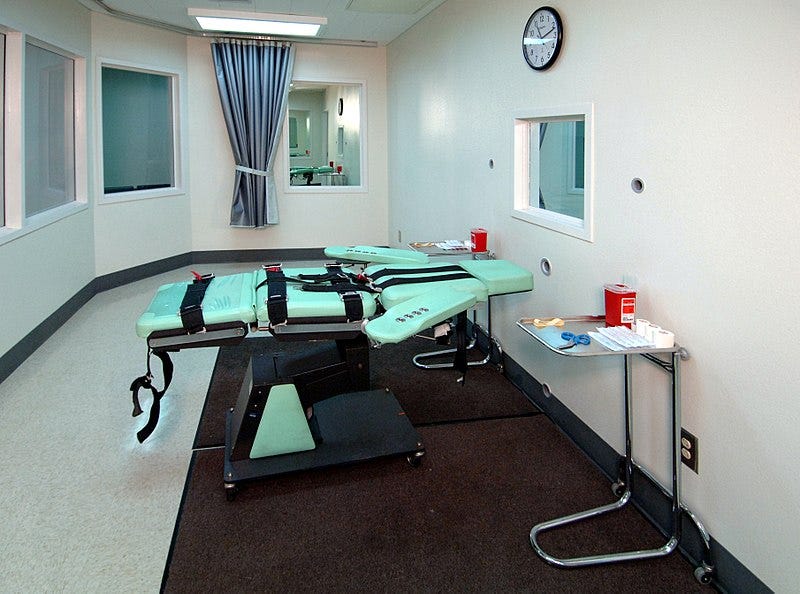
This work was created by a government unit (including state, county, city, and municipal government agencies) that derives its powers from the laws of the State of California and is subject to disclosure under the California Public Records Act (Government Code § 6250 et seq.). It is a public record that was not created by an agency which state law has allowed to claim copyright, and is therefore in the public domain in the United States.
Being a bit behind in getting ready to publish my Friday post, I decided to put my situation into my meditation session. What should I write about without bringing more confusion into this world?
After my meditation session, I opened my email to see a request to stop the scheduled execution of a prisoner convicted of murder. I decided that this was meant to be the topic of my post.
A murder is probably the most intimate and painful event that one can imagine. That is true not only from the victim’s perspective, but from the perspective of the victim’s family and friends. They suffered reflecting on the victim’s ordeal and the loss of that precious being.
I have been supporting the Texas Coalition to Abolish the Death Penalty for several years and have written numerous letters to the Board of Pardons & Parole seeking the commutation of the sentence to a lesser penalty, and to the State Governor seeking his support to spare the life of the condemned individual. During the preparation to write the letters I have read court records and appeals from organizations against the death penalty. I have used the details of the events around the murder to understand the victim/murderer dynamic— the tragedies that murder cases are for victims, offenders, their families, and friends.
The convicted murderer that is the subject of the email to which I alluded does not dispute guilt. Appropriate punishment is dictated. By law, however, a murderer is to be sentenced to death only if there is a credible possibility of the prisoner’s future danger to society.
My concerns:
1. In the case at hand, the prosecution relied on influential, yet unscientific and unreliable testimony from a psychiatrist that testified that the convicted inmate presented a future danger to society. However, the psychiatrist never met nor assessed the inmate prior to his fateful testimony before the impressionable jury. That kind of “expert testimony” has been discredited by the American Psychiatric Association. The psychiatrist had presented no books, articles, or studies in support of his assertion. How acceptable is this practice in a system that seeks justice?
2. The prisoner’s defense counsel failed to object to the psychiatrist’s testimony. As a result, the court’s protocols did not allow the defense counsel to present the flaws of that testimony during the subsequent appeals process. Why do we allow procedure to trump compassion?
3. The prisoner’s defense counsel failed to present the jury with a comprehensive mitigation case addressing the prisoner’s background that would have better informed the jury, prior to sentencing, of the prisoner’s mental state at the time of the offense. The prisoner had a history of major depression, severe anxiety, and substance abuse. This history included neglect, abuse, and family dysfunction in the prisoner’s development. The prisoner suffered from brain dysfunction that affected decision-making ability and impulsivity. All these factors played a role in the murder. How just is it to execute a prisoner not in full control of mental faculties?
4. The convicted prisoner was under twenty years old at the time of the murder. The human brain is still developing, especially in the prefrontal cortex, prior to the age of 25. That area of the brain governs our decision-making capacity. There is no scientific evidence that supports future dangerousness at that state of mind development. How moral is it to execute a prisoner with a still developing brain?
5. The convicted prisoner had no record of violence during decades on death row. In this case, what is the basis of future dangerousness to society?
Is it moral, just, rational, reasonable, necessary to execute a human being based on unscientific testimony of mental conditions that are unsupported by facts?
How can a legal system be allowed to apply a death sentence under these circumstances?
What do you think?

I also strongly oppose the death penalty, especially in a system where the more money you have the better lawyer you can get and, of course, if you can't pay you don't get decent representation.
Thank you for all your work.💙